And the Greek “Destruction”
The final judgement of the wicked, in the eyes of many in Western culture, has become the most offensive of Christian teachings. Eternal conscious torment in hell is unpleasant enough to people’s sensibilities that the doctrine has been rethought by the Church of England. To soften the Christian stance on judgement, the Church’s Doctrine Commission reported in 1995 that Hell may be a state of “total non-being”, not eternal torment. So, those consigned to hell are, effectively, annihilated.
So, the Annihilationists (now in much greater number) believe that the state of the wicked, in the end, is total… annihilation. They cease to exist. As such, the word “destroy” or “destruction” in scripture becomes critical to their understanding of end-time or “last things” theology (Eschatology). The vast majority of the appearances of those words in the New Testament are rendered as such from the original Greek apollumi.
But Vine says of that word, “The idea is not extinction, but ruin or loss, not of being, but of wellbeing.” (Vine, W.E., Vine’s Expository Dictionary of Old & New Testament Words, Thomas Nelson, Inc., Nashville: ©1997, P. 294)
Young defines apollumi as “to loose, loose away, destroy” (Young, LLD, Robert, Young’s Analytical Concordance of the Bible, Wm. Eerdmans Publishing Co., Grand Rapids: ©1962)
And The New American Standard New Testament Greek Lexicon treats apollumi as follows (from BibleHub.com’s treatment of Matthew 7:13, https://biblehub.com/lexicon/matthew/7-13.htm):
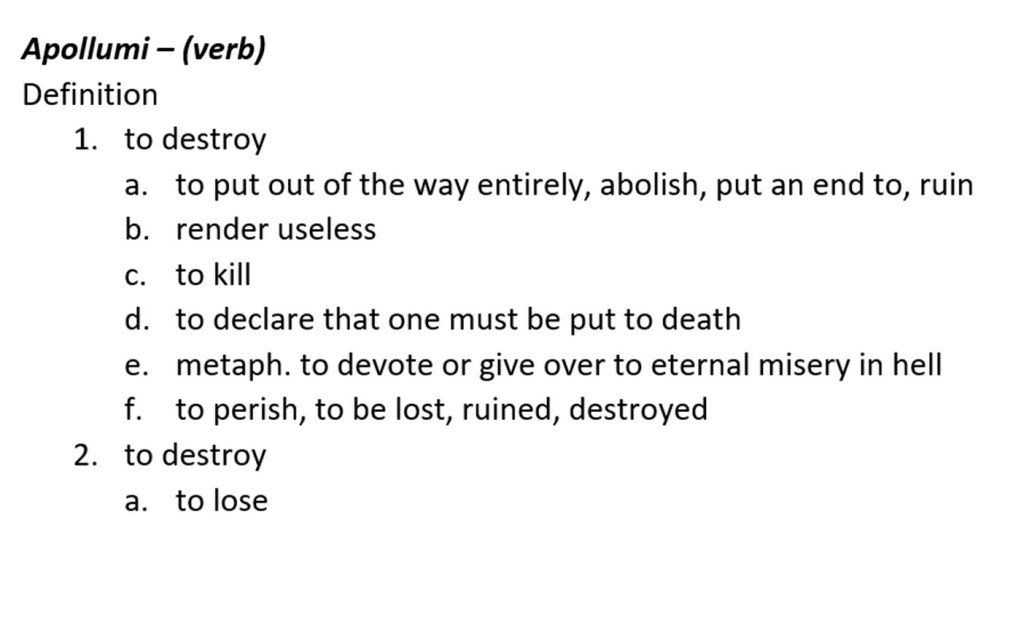
A lexicon is a dictionary with a variety of tools to help the reader more fully understand the word being treated. These definitions are not necessarily biblical, as a matter of fact they commonly are not. The Greek lexicon makes use of many resources when identifying how these words were used in the vernacular of antiquity (in everyday usage, thousands of years ago). The writings of Plato and the other philosophers are consulted, as are the writings of emperors such as Alexander the Great and Julius Ceasar, the writings of historians, and of Homer and Greek mythology.

Additionally, the writers of lexicons will consult the church fathers (those who led the church for the centuries immediately following the death of the Apostles), the apocryphal writings, and the Septuagint (the Greek OT referred to in writing as LXX) to try to understand how a particular Greek word is used in the New Testament. It is not uncommon for a newer lexicon to stand “on the shoulders” of an older version, using the research done previously, making it possible to carry outdated commentary forward where newer discoveries had impacted what had been written earlier.
Above we have two definitions, the primary and secondary meanings of the Greek word apollumi, both defined as “to destroy”. The primary definition is further broken down into six subs, all of which favor the destruction of the direct object – except one. That one (e) favors eternal torment. The abbreviation, “metaph.”, stands for “metaphysical” meaning philosophical or religious in this context.
I believe that what we are looking at here is the writer’s bias exerting itself and influencing the definition of the Greek verb, apollumi: and consequently, impacting the way passages of scripture dealing with the punishment of the wicked are interpreted.
- metaph. to devote or give over to eternal misery in hell
Of all the ancient sources of insight into the NT use of the Greek apollumi, none (as shown below) wrote of “eternal misery in hell.” To include this definition seems out of place and exposes it as a clear case of the tail wagging the dog. It seems obvious that this 5th sub-definition was arrived at by working backwards from the rendering of the word in old English versions of the New Testament. Think about it, a lexicon is consulted to investigate how a particular word in the original scriptures should be understood. We do not look to the English New Testament to determine the meaning of a word found in a lexicon. But that seems to be exactly what is happening with (e) above.
Liddell & Scott’s Greek-English Lexicon has been the most comprehensive ancient Greek dictionary in the world. It includes every surviving ancient Greek author and text discovered up to 1940, from the Pre-Classical Greek of Homer and Hesiod to Classical Greek to the Hellenistic period, including the Greek Old Testament – the LXX.
In Liddell & Scott apollumi is used to convey the thought, “to destroy utterly, kill – mostly of death in battle” and cites Homer as the source. It is rendered as “will waste away my substance” in the Odyssey, “drove me to ruin” in Euripides, and even to “talk or bore one to death” in Sophocles.
Aristophanes uses apollumi to convey the idea, “you are lost”, the Odyssey again uses the word, this time, rendered “loses one’s life”. “O destined to a miserable end! O thou villain, scoundrel, knave!” is the idea conveyed in Aristophanes again.
“Lost” in Translation
Liddell & Scott cites the LXX rendering of apollumi as “lost”: for example, “the donkeys of Kish, Saul’s father, were lost…” (1 Samuel 9:3 LXX). Interestingly enough, in Jesus’ parable of the one “lost” sheep of the 99, apollumi is the Greek word used (Luke 15:1-7), as it is for the “lost” coin (Luke 15:8-10), the “lost” sheep of the House of Israel (Matthew 10:6), and the father of the prodigal proclaimed, “because this son of mine was dead, and is alive again—he was lost and is found!” (Luke 15:24 NET) Yes, apollumi is rendered “lost” in that passage too. Finally, in expressing the objective of Jesus’ visitation, Luke uses the word apollumi when he writes, “For the Son of Man came to seek and to save the ‘lost.’” (Luke 19:10 NET)
Jesus would not have come to seek anyone that was permanently lost, nor would He have sent His disciples two by two to the lost sheep of the House of Israel if they could not have been saved. The lost coin was indeed found as was the one lost sheep of the 99 and the prodigal’s son was not being brought up the road to his father dead in a cart – he was alive. Yes! Even the donkeys of Kish found their way home.

What I didn’t find in the spreadsheet I created of nearly 100 occurrences of the word, is anything that would substantiate eternal conscious torment or annihilation for that matter. This and the fact that the metaphysical definition given above is basically opposite the rest of the entry for the Greek verb, apollumi, gives me serious pause. It should do the same to anyone interpreting apollumi as indicating a condition of the object being described as irretrievably lost, perished, or destroyed.
There are 39 passages in which the English “perish” appears in the NT (KJV). Of those, 33 are rendered as such from the Greek word apollumi and are dealing specifically with physical death (21 times) or the loss/destruction of an object in the natural world (12 times). An eye, a hand, a wine bottle – twice, a hair, food, money, the earth and the heavens, ordinances, natural beauty, gold and the antediluvian world in those 12 passages are said to perish, but these are not metaphysical applications of apollumi.
Death, as we know it, is not eternal and the 21 passages in which perish is referring to it do so with regard to pigs, twice that believers do not perish, a weak brother, the outer (natural) man, Christ Himself, and in two of these passages, God says specifically that it is His will that the little ones, or anyone for that matter, should not perish.
To be lost, ruined, rendered useless, or put out of the way entirely could certainly describe those, individually, whose names are not found written in the Lamb’s book of life and subsequently are cast into the lake of fire for chastisement, refinement, or purification – the punishment of the ages to come. That could be a very long time – but it is not eternity.
In his book, All in All, A. E. Knoch writes:
As we have often pointed out, the statement that the Son of Mankind came to seek and to save that which is lost (Luke 19:10 CLNT) is the key to the meaning of apollumi. It refers specifically to Zaccheus. He was lost, destroyed. Because he was lost, he was ready to be found and saved. The real object of most false definitions of apollumi is to prove that it means death from which there is no resurrection, practical annihilation, a state from which salvation is impossible. This passage directly destroys that idea (no pun intended). Instead of the lost being beyond salvation, they alone are eligible for [it]. You cannot rescue a man who is safe and sound. It is only when he is in the state denoted by apollumi that salvation can operate on his behalf.
Antithetic statements, such as this, are of great value in the study of words. The terms seek and save are accurate indications of the opposite of destroy. One who is destroyed must be lost, or no one would seek him. He must be in a state which calls for salvation or Christ would not have come for him. This passage proves beyond peradventure that destruction is a salvable condition, not a state beyond the reach of deliverance. Add to this the fact that only the lost are saved, and it reverses the usual idea of destruction. God seeks what He has lost. (Knoch, A.E., All in All, The Goal of the Universe, Almont, MI: Concordant Publishing Concern, ©1978, Pp. 69-70.)
When we think of something being destroyed, most of the time we think of obliteration, demolition. However, it is apparent that when the writers of the New Testament used the word apollumi, this was not the case. Language translation is a complicated endeavor, particularly when translating from an ancient dialect.
There were stark differences in cultural traditions, symbols, norms, values and beliefs among those who translated the manuscripts from Greek and Aramaic to Latin and from Latin to English. These differences, as well as the various political climates that existed in the regions from which these versions, translations and copies come, act in concert to create an environment that had an impact on the version or translation produced. There are words that do not translate well from one language to another, ideas and concepts that are familiar to one but foreign to another culture. Words change meaning over time, there are words that do not exist in some languages and words become archaic and fall from use.
In reading the KJV of the New Testament for instance, we must contend, not only with peculiarities in the Greek, Latin and English languages (they do not always line up nicely), but with how a 17th century English translator interpreted a 4th century Latin translation of 1st century Greek manuscripts so that a 21st century American Christian can read the 17th century King’s English which her 21st century countrymen can no longer understand.
What does seem to be clear is that rendered lost, apollumi does not mean lost forever; rendered perish, meaning death most of the time, it is not permanent and irreversible; and rendered destroy, does not mean completely obliterated. If a reader sees “lost”, “perish”, or “destroy” as being an eternal condition, from which there is no salvation, they have placed that idea in their own minds themselves.
 Biblical Universalism